Healthcare
Sodexo Healthcare: Putting safety first

When patients walk into a hospital, their first impression isn’t shaped by credentials; it’s shaped by what they see, feel and experience in the environment around them. Cleanliness is often viewed as a simple operational metric, but in reality, it plays a far more powerful role in shaping patient perception, trust and satisfaction.
Environmental Services (EVS) isn’t just about cleaning — it’s a strategic driver of both patient experience and safety outcomes.
Patient satisfaction and hospital performance are closely linked. Facilities with stronger patient experience scores tend to see higher patient volumes, better reputations and improved financial performance. Conversely, poor first impressions — like an unclean restroom or visible clutter — can immediately erode trust.
Even in high-stress environments like the Emergency Department, where patients are more focused on wait times or pain management, the surroundings still matter. Details like clean linens, spotless floors and well-maintained privacy curtains influence patient confidence, perceived safety and anxiety levels.
Put simply: patients equate what they see with the quality of care they expect to receive.
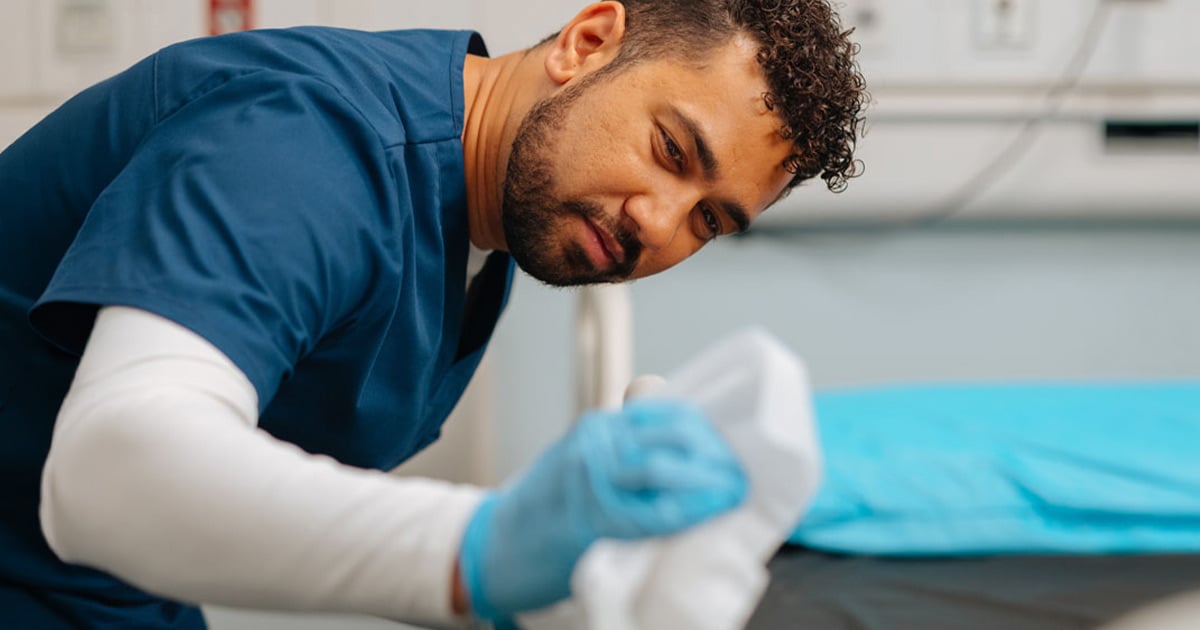
Here is a critical point to consider: how cleaning is delivered is just as important as what is cleaned.
Patients respond strongly to visible cues:
These small but intentional actions reinforce confidence that the environment is safe and consistently maintained.
But even more impactful is the human connection EVS professionals bring. Unlike many clinicians, EVS staff often spend more uninterrupted time in patient rooms. These interactions create opportunities for reassurance, communication and emotional support — key drivers of patient satisfaction.
A real-world example illustrates this well: increasing EVS rounding and patient engagement at one health system led to a 6.6% increase in HCAHPS cleanliness top-box scores, outperforming national benchmarks.
Here’s where things get more complex.
There is a distinct but surprising relationship between patient-reported cleanliness (HCAHPS scores) and actual infection outcomes (hospital-acquired infections, or HAIs). The findings challenge a common assumption: that cleaner hospitals, as perceived by patients, have fewer infections.
In reality, the correlation is weak and inconsistent.
This reinforces a critical point: patient perception of cleanliness does not reliably reflect microbiological safety.
Why? Because HCAHPS cleanliness scores are inherently subjective. They measure what patients see and feel, not the clinical effectiveness of disinfection — and they’re limited to rooms and bathrooms, not the full care environment.
The key: consistency drives confidence.
Standardized training, repeatable processes and aligned messaging reduce uncertainty for patients. When every EVS team member delivers a consistent experience, patients perceive professionalism and reliability. Equally important is culture. Recognition programs and team integration help EVS staff feel valued as essential members of the care team. That engagement translates directly into better patient interactions and better outcomes.
EVS is no longer just a support function. Instead, it’s a strategic lever for improving patient experience, protecting safety and strengthening brand reputation.
Healthcare organizations that succeed in today’s environment will be those that:
In modern healthcare, EVS is no longer measured solely by what it cleans. Its true value lies in how effectively it supports trust, safety, consistency and the overall patient experience. Because in the end, patients don’t just remember whether a hospital was clean. They remember how it made them feel.
Sodexo’s Protecta® program helps healthcare organizations strengthen patient trust, improve consistency and support safer care environments through standardized protocols, training and performance-driven solutions. See how it can help your team deliver confidence at every touchpoint.