Healthcare professionals in scrubs gathered in discussion in a clinical setting.

Outsourcing, in plain language

Before you can evaluate whether outsourcing is right for your organization, it helps to know what the terms actually mean and what you'd actually be agreeing to.

Keep reading

Understanding outsourcing in a healthcare setting

Outsourcing comes with its own vocabulary. Before you can evaluate whether a partnership makes sense for your organization, it helps to know what the terms actually mean, what you'd be agreeing to, and how these relationships are typically structured.

Not all partnerships are structured the same way

Person in work attire cleaning the handrail of an escalator with a cloth and protective gloves.

Self-operated

Your organization retains full control. You run the service with your own employees and resources, and you carry full responsibility for performance and cost. The provider assumes nothing, because there is no provider involved. This model tends to fit organizations with strong internal capability and no urgent pressure to change.

Terms worth knowing

  • Steering wheel icon inside a circle, representing driving, navigation, or transportation control.

    Losing control of decisions that matter to your organization.

    Every model we offer, even the ones that transfer the most operational responsibility, still involves you in the decisions that shape your organization's identity and standards. What changes is who handles the daily execution, not who sets the direction.
  • Process flow with three completed checkpoints connected by a curved path and a right-pointing arrow.

    A one-size-fits-all handover of every service you run.

    Partnerships can start with one service line and stay there, or expand over time. There is no requirement to outsource everything at once, or ever, and many organizations choose to keep some services in-house indefinitely.
  • Clipboard checklist with completed and incomplete items alongside a pencil for review or editing.

    Permanent or irreversible on terms you didn't agree to.

    The structure, scope, and terms of a partnership are defined in the contract your organization negotiates and agrees to. Nothing about outsourcing as a category locks you into terms you haven't reviewed and accepted.
  • Fingerprint icon with concentric ridges, representing identity verification, security, or authentication.

    A replacement for your identity or your standards.

    A partner is there to support how you already define quality, culture, and care, not to redefine it. The commitments that matter to your organization are the ones the partnership is built around, not the ones it replaces.
Two healthcare workers walking down a hallway while reviewing information on a clipboard.

Once the language makes sense, where does the value come from?

Understanding the terms and the models is the first step. The next is understanding where the value actually comes from, and what a partnership would realistically look like for your organization.

See how partnership creates value

What a partnership can include

  • Food & nutrition

    Where care, recovery and economics come together. From identifying and treating malnutrition to turning dining into part of the healing experience, this is where clinical outcomes and everyday hospitality meet.

    Patient receiving a meal tray from food service staff while resting in a hospital bed.
  • Facilities & environment

    The foundation of safe, reliable care. Lower infection rates, survey-ready facilities and equipment that works as it should, so your team spends less time reacting and more time confident in what's already in place.
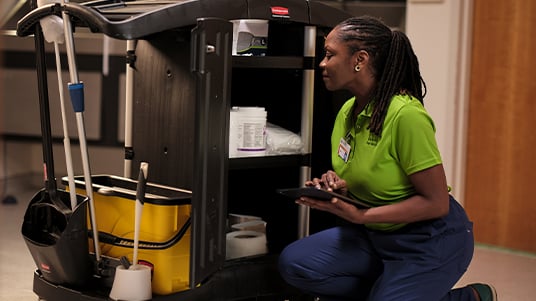
    Environmental services worker inspecting and restocking supplies on a cleaning cart in a healthcare facility, highlighting sanitation operations, infection prevention, and facility support services.
  • People & workforce

    The stability that keeps care consistent when it matters most. Roles get filled and stay filled, experienced staff stay and grow, and coverage doesn't drop when people leave.
    Healthcare team members gathered in a hospital corridor reviewing information on a tablet, highlighting clinical collaboration, care coordination, workforce engagement, and patient support services.
  • Experience & hospitality

    How patients and families feel your care. A consistent, intentional hospitality culture that shows up in higher satisfaction, more cohesive service, and confidence that carries beyond the visit itself.
    Healthcare support professional assisting a patient in a hospital room, highlighting personalized care, patient comfort, clinical support services, and a positive healthcare experience.

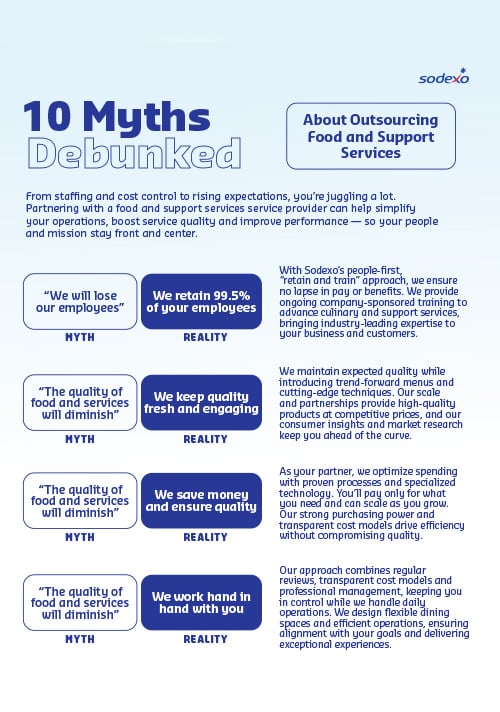
10 things healthcare organizations assume about outsourcing that usually are not true

A lot of what people believe about outsourcing turns out to be outdated or simply wrong. This short guide clears up the most common misconceptions we hear from healthcare leaders who are exploring outsourcing for the first time.

Infographic debunking outsourcing myths, comparing common concerns with Sodexo service realities and benefits.

Loading component...

Loading component...

Loading component...

Loading component...

Loading component...

Loading component...

Explore first time outsourcing in healthcare

Choose the topic that fits where you are in your understanding and need for outsourcing food and support services

See what a partnership with Sodexo could look like