Campus
Higher education facilities management: The view from both sides of the table


On most campuses, utilities are one of the largest day-to-day expenses, yet they rarely get executive attention. Utility expense management turns hundreds of confusing water, electric and gas bills into actionable insight, recovering billing errors and helping campuses control spend. We spoke with Linda Tumlinson, Manager of Energy Intelligence at Sodexo, who leads this work for colleges and universities, about what she finds in campus utility bills and where leaders should start.
See how utility expense management works in practice.
My background is in physics, and I came to utility expense management by an unexpected route. A colleague who had founded an energy-audit business encouraged me to enter the field, and I pursued the certifications to become a commercial energy engineer and a commercial energy auditor.
Working as an auditor, I learned that sound analysis depends entirely on the quality of the underlying data. That focus on data quality is what led me into utility expense management and eventually to Sodexo, where I now work with colleges and universities to bring that same rigor to their campuses.
To most people, a utility bill is something you pay and forget. Pay it, or the lights go off. But what I see is a year-over-year story about where a building is quietly losing money. That's the work I do at Sodexo. I take the water, electric and gas bills that pile up across a college or university and turn them into something leaders can actually use: recovered dollars, benchmarked consumption and a clear plan to spend less, because almost every campus I work with is sitting on savings it can't yet see.
Most campuses treat utilities as a necessary evil. You have to pay the bill or you get shut off, so you pay it. And trying to dispute a charge is discouraging by design: You sit on hold, you finally reach someone, you explain the problem, they promise a credit on your next bill. When it doesn't appear, you're back on hold again. At some point you ask yourself how much your time is worth, and you decide to just pay it.
I understand that instinct completely. But it leaves campuses with almost no visibility into their own spend. Most have no idea where their highest areas of consumption are, or how they compare to other institutions in their area. There's no easy-to-use database where you can plug in your numbers and get a number back. It doesn't exist, so people assume there's nothing they can really do. That's the assumption I spend my days proving wrong.
If a CFO or facilities director could do just one thing this quarter, it would be this: Know your numbers. How am I doing this year compared to last year? How am I doing compared to my peers? We answer that by benchmarking three different ways.
Against local peers: We pull CBECS data — the same dataset Energy Star uses — and match each campus to institutions as close as possible in size and type within their area. It's a very specific comparison, so they can see how they stack up.
Across the portfolio: For campuses with individually metered buildings or multiple campuses, I look at where consumption per square foot is highest, ask why and target it to bring the cost down.
Through Energy Star and compliance: Energy Star doesn't yet have enough campuses to produce a benchmark number, but 83 municipalities across the U.S. have benchmarking compliance requirements. We enroll campuses in Energy Star and keep them compliant wherever that's mandated.
A large commercial bill, which is what most of our campuses receive, can carry up to 92 individual data points. That's a tremendous amount of information just sitting there, and without a system to interpret it, it never gets used.
Here's an example: A K-12 private school came into our system in January. They knew something was wrong with their bills but couldn't figure out what. We ran a historic audit of their bills alongside their current ones, and we found five construction meters that had been physically pulled the previous May. The meters were gone, but the utility and the supplier had kept right on billing estimated charges.
They came to us in January. By February, we had a refund check in their hands for $258,000.
All told, we've saved our clients over $8 million by catching estimated meter reads, and every dollar of it goes to them. We keep zero shared savings, which is unique in our industry.
Here's how it works: It's not uncommon for a utility to miss a read and drop in an estimate. That's normal. What isn't acceptable is letting those estimates run high, month after month, unchecked. So we run a dedicated audit for estimated reads, and my vendor management team acts as the client's agent with the utility. Because we're watching it from the moment it starts, we make sure it stops.
When an estimate looks too high, we push back. If the utility agrees on a fairer number, we build a pro forma bill so the client pays a reasonable amount. If they won't agree, and often they won't, I tell the client it's an estimated bill, we believe it's high, but to go ahead and pay it anyway, because the late fee stands whether or not they owe that much. Then we follow up the next month. If it reaches a third estimated cycle, we have someone from the utility go on site, meet our director at the meter and find out why it isn't being read.
My vendor management team handles the correction from start to finish. In most cases, our clients don't even know an error occurred until they see it resolved in their monthly or quarterly report: every exception we caught, what we cleared, what we did, and how much money is coming back to them. We don't involve their business office at all.
That matters more than ever, because campus accounting teams are stretched thin. Fewer graduates are going into accounting when entry-level pay is low, and a lot of these roles have been held for 20-plus years by baby boomers who are now retiring. There's little middle management behind them, and those openings are hard to fill. Taking utility bill management off their plate removes a real workload from a department that's already carrying too much.
This is where that portfolio benchmarking pays off. I trend consumption by building type, and that tells me quickly where effort actually pays off. A laboratory, for instance, runs high because equipment operates 24 hours, so it's a difficult and unrewarding first target. I'd rather focus on classrooms, student buildings and kitchens, where there's a lot we can do on both the back of the house and the front of the house.
Trending also lets us make savings social. Comparing dorm against dorm, a campus sustainability team can run friendly competitions. We tell them their numbers, and at the end, maybe there's a pizza party for the winning hall. We've done exactly that, and it's genuinely fun. One campaign I love is "Dining in the Dark": at a well-lit lunch, we turn off the overhead lights and let students know how many kilowatt-hours and dollars it saved. They might get a sticker that says "I participated in Dining in the Dark."
It creates real awareness and gets students thinking about what they can do. When they understand what it means and how it helps, and when you give them practical tools to take with them, they absolutely respond. The key is translating numbers into something they can understand. We give campuses equivalencies: a reduction in greenhouse gases expressed as the equivalent of planting 10 acres of trees, or taking 2,000 cars off the road. That makes it real for students and faculty alike.
Everything I've described rests on one principle: The more information you have, the better your decisions. That's exactly what the EPA says — you must measure. It's why they built Portfolio Manager, and it's why our system feeds data into Energy Star Portfolio Manager automatically. As an Energy Star partner, I work closely with them to make sure we're using the latest technology and information to help our campuses.
From a $258,000 refund to a dining hall full of students learning what a kilowatt-hour costs, my work comes down to one thing: giving campuses a clear, comparable view of where their money and their energy actually go.
If you're a campus leader, start by knowing your numbers. Everything else follows from there. Most institutions are sitting on savings they simply can't see yet, and helping them find it is the part of this job I love most.
The biggest utility savings aren't found in a single bill but across hundreds of meters, audited line by line. Our utility expense management overview shows how 200+ standard audits, benchmarking and consumption trending uncover billing errors and prioritize the buildings that deserve attention first.
Beyond recovering billing errors, consistent utility expense management gives campus leaders the visibility to control spend, meet compliance mandates and advance sustainability goals. Learn how Sodexo's utility expense management experts audit, benchmark and trend your utility data to find savings others miss.
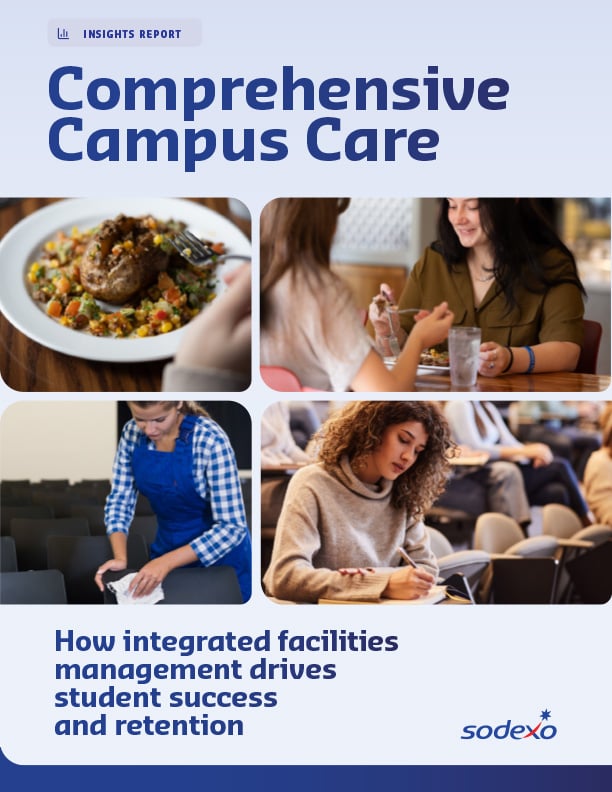
Download the Comprehensive Campus Care Insights Report to see what the data reveals about how a well-maintained campus shapes enrollment, belonging and retention — and shows how an integrated approach to facilities connects everyday cleaning, grounds and building operations into a single strategy for keeping students. The same principle that turns hundreds of confusing utility bills into actionable insight applies across campus care. The numbers are already there, waiting to show you where to act. You'll come away with a clearer view of where campus care can move the numbers that matter most on your campus.
Fields marked with * are mandatory.